The FoodFamilies of France as observed in Paris and Caen in March 2007
The Bagette Family, whose major constituents are big and small & long and short breads of all sorts, is probably the First FoodGroup of France. Its stars are croissant, pain au chocolat and almond croissant... Cousin to Bagette is The Crepe Family, with siblings Crepe and Gallette. Unlike their cousin Croissant, they are NOT served at breakfast (petite dejuner, if you will). They live side-by-side on menus in creparie (Houses of Crepes) which, unlike American McDonalds, which are strategically located within a few blocks of one another in large cities, there are streets in Montparnasse with 20 Maisons des Crepes on a block. You can get anything you want in a crepe, as long as it's sweet: my fave is simple: crepe, sugar and fresh lemon juice. You can get anything you want in a gallette, as long as it's savory. No, I didn't know that a gallette was a buckwheat pancake.
My personal favorite, The Pomme (apple) Family, is most useful, as it contains Calvados -- a spirit-lifting apple liquer -- which is either part of or the totality of the Tru Normande, the shot of Calvados served mid-meal in Normandy to create the "Norman Hole" in your stomach so that you can finish your meal. How civilized. A more festive and flexible Tru Normande can also be served in a shot glass: a scoop of apple sorbet topped with Calvados. There is Pomme in alcoholic apple cider which is the star of Kir Normande (cider with Cassis), which should be everyone's everyday refresher and has bumped the ever-popular Spanish sparkling wines from my house. The Pomme Family is also home to apple strudel, apple tart and tarte tatin, which can complete any meal and will signifcantly raise the stakes for snacks. France is also home to exquisite juices -- go to any grocery and find fabulous "Pomme" or "Pomme and Cerise" (apple and cherry) juices.
At Mark Bittman's recommendation, I found the World Headquarters of France's Falafal Family, L'as du Falafal on Rue des Rosiers in Paris. As always, Bittman is right. Put this on your list of "Foods I must eat in Paris." And after your Falafal, go across the street to Florence Finkelsztajn's Boulangerie for apple tart.
The Fruit and Frite Family is outstanding. There is apparently law prohibiting selling any fruit or veg that isn't perfect. I was in outdoor markets in Paris and in Caen, and in grocery stores in Paris, Caen, Bayeux and Honfleurs. The mushrooms are packed like little jewels; the radishes sit up and salute, and the strawberries and tomatoes were both beautiful and they tasted just like they were supposed to taste.
Clearly the French worship both Jambon and Fromage (ham and cheese). The variety of fresh and cured hams and sausage is overwhelming, and many more expert than I have made their careers on cataloging French cheese. I just ate.
Any vist to Caen requires careful examination of the Poisson and Fruits de Mers Families. I ate Coquilles St. Jacques, lobster, salmon and smoked salmon, and nothing was found wanting except that I wanted to be able to have fish that fresh every day of my life.
French folk take their food seriously and I am grateful for it. And I apologize for misspelling any French words.
Sunday, April 22, 2007


Cooking Class Noodles: One roadmap - two recipes
http://susan-cooks.blogspot.com/2007/04/food-families-of-france-march-2007.htmlOne of the signs of spring in my kitchen is "Cooking Class!" with Amy, Erin and Rochelle, three grads of the U of Minnesota Law School. Amy and Erin trekked to St. Paul this weekend and we worked through five recipes that might not go together for a single meal, but each will contribute to both festive occasions and weeknight dinners.
Cooking Class Recipes: Kir Normande, Nigella Lawson's Lemon Lime Creams, Marian Burros' Plum Torte, and two rice noodle stir frys from Cook's Magazine's Complete Book of Pasta and Noodles (Clarkson, 2000).
KIR NORMANDE Kir Normande is a sterling representative of the Pomme (apple) Family, my favorite of the FoodGroups of France. The most accessible way to recreate my recent trip to Paris and Normandy, it requires some zesty alcoholic apple cider (right now I prefer French, but I suspect that in a few months, I'll go right back to Woodchuck, my favorite American label) and Cassis. Yes, this is the Norman version of Kir Royale, and it perks up everything. Also try a non-alcoholic version: non-alcoholic cider with a splash of pomegranate.
MARIAN BURROS' PLUM TORTE Why don't you own The Best of DeGustibus (Simon and Schuster, 1988)? Marian Burros wrote about food for the NY Times for years, and many of her columns were collected this book. It is a window on how we shopped and ate and thought about food during the 80s, and it is full of terrific recipes, including the famous Plum Torte, which she reports was the most requested recipe ever published by the Times. And why not? It is perfect: it's simple; it's reliable; it's expandable; it freezes; and it never, ever disappoints -- except, perhaps in the short time that it sits on the table or on the counter before it disappears. It is a cookie dough that wraps itself around stone fruits and transforms them.
If you freeze torts in springform pans, pop off the metal bottoms and triple wrap the torts. A tort from your freezer puts the flavors of summer on your table in the middle of the winter. Double the batter ingredients to fill a 9x13" pan.
NIGELLA LAWSON'S LEMON -LIME CREAM (New York Times, April 2, 2003, p. D3) We used it to sauce the torte, which was gilding the lily. Lemon-Lime Cream is outrageously sinful, ridiculously easy and always accessible because lemons and limes, cream, sugar and eggs are ALWAYS in the grocery store.
THIS IS STUPID EASY. In a large bowl or in a blender: mix the zest and juice of 2 lemons and one lime, 1-1/2 cups sugar, 6 large eggs,1-1/4 cups heavy cream. Cover and refrigerate for between 2 to 48 hours. Bake at 300 degrees in six one-cup ramekins placed on top of a dish towel set in roasting pan. Pour hot water half way up the sides of the ramekins. Check them at 45 minutes: they should be just set with the centers slightly wobbly. Remove from the water and allow to cool. [Tongs are a great tool for this.] Serve at room temperature or cover with plastic wrap and refrigerate.
STIR FRIED RICE NOODLES two ways: One roadmap and two recipes from Cook’s Magazine Complete Book of Pasta and Noodles
The editors of Cook's Illustrated focus so closely on technique that even novice cooks can move through their recipes fearlessly. Although I own most of their books, it's this one that I turn to again and again because they tell me how to do it -- whatever it is. Thanks, Cook's.
It took about two minutes of careful parsing to realize that except for a few ingredients, these recipes were identical. After some cheerful chopping (with Kir Normande as inspiration), with two of us at the stove and one navigator/timer we were able to get both of these dishes to the table in under ten minutes. You could probably stir fry these on a giant wok on a high-heat outdoor gas grill.
The instructions in both recipes are identical in numbers 1 and 2 -- boil noodles and heat the oil in the pan. In number 3, you are guided to add the particular ingredients for for stir frying; and in number 4 you add the noodles and the sauce ingredients.
Stir-Fried Rice Noodles with Shrimp, Pineapple and Coconut Cream (p. 430)
12 oz thick rice noodles
salt
¼ cup peanut oil
8 oz shrimp, peeled and coarsely chopped
4 medium garlic cloves, minced
1 T minced fresh ginger
1 medium jalapeno or small fresh hot chili
3 T fish sauce
1 T sugar
½ c light coconut milk
1-1/2 c fresh diced pineapple
Stir fried rice noodles w/ coconut curry sauce (p. 431)
12 oz thick rice noodles
salt
¼ c peanut oil
1 medium red bell pepper, stemmed, seeded, diced small
½ # sugar snap peas, stringed (we used green beans)
4 c shredded Napa cabbage
4 medium cloves of garlic, minced
1 T minced fresh ginger
2 T soy sauce
1 T fish sauce
1 T sugar
½ c light coconut milk
2 T curry powder (we used Penzey's Sweet Curry; I would mix 1T Sweet and 1T Hot)
Cooking Class Recipes: Kir Normande, Nigella Lawson's Lemon Lime Creams, Marian Burros' Plum Torte, and two rice noodle stir frys from Cook's Magazine's Complete Book of Pasta and Noodles (Clarkson, 2000).
KIR NORMANDE Kir Normande is a sterling representative of the Pomme (apple) Family, my favorite of the FoodGroups of France. The most accessible way to recreate my recent trip to Paris and Normandy, it requires some zesty alcoholic apple cider (right now I prefer French, but I suspect that in a few months, I'll go right back to Woodchuck, my favorite American label) and Cassis. Yes, this is the Norman version of Kir Royale, and it perks up everything. Also try a non-alcoholic version: non-alcoholic cider with a splash of pomegranate.
MARIAN BURROS' PLUM TORTE Why don't you own The Best of DeGustibus (Simon and Schuster, 1988)? Marian Burros wrote about food for the NY Times for years, and many of her columns were collected this book. It is a window on how we shopped and ate and thought about food during the 80s, and it is full of terrific recipes, including the famous Plum Torte, which she reports was the most requested recipe ever published by the Times. And why not? It is perfect: it's simple; it's reliable; it's expandable; it freezes; and it never, ever disappoints -- except, perhaps in the short time that it sits on the table or on the counter before it disappears. It is a cookie dough that wraps itself around stone fruits and transforms them.
If you freeze torts in springform pans, pop off the metal bottoms and triple wrap the torts. A tort from your freezer puts the flavors of summer on your table in the middle of the winter. Double the batter ingredients to fill a 9x13" pan.
- Cream 1 cup sugar and 1/2 cup unsalted butter. Mix (stir well or sift) 1 cup flour, 1 tsp baking power and a pinch of salt. Add to the sugar and butter. Add two large eggs to the batter. Spread it into a 9" springform pan or other round or square pan.
- Top with 24 halves of pitted Italian or other plums or stone fruits. Sprinkle with cinnamon, sugar and lemon juice. (I have often forgotten to do this and no one noticed.)
- Bake at 350 for an hour. If baking from frozen, bake for about 30 minutes at 300 degrees.
NIGELLA LAWSON'S LEMON -LIME CREAM (New York Times, April 2, 2003, p. D3) We used it to sauce the torte, which was gilding the lily. Lemon-Lime Cream is outrageously sinful, ridiculously easy and always accessible because lemons and limes, cream, sugar and eggs are ALWAYS in the grocery store.
THIS IS STUPID EASY. In a large bowl or in a blender: mix the zest and juice of 2 lemons and one lime, 1-1/2 cups sugar, 6 large eggs,1-1/4 cups heavy cream. Cover and refrigerate for between 2 to 48 hours. Bake at 300 degrees in six one-cup ramekins placed on top of a dish towel set in roasting pan. Pour hot water half way up the sides of the ramekins. Check them at 45 minutes: they should be just set with the centers slightly wobbly. Remove from the water and allow to cool. [Tongs are a great tool for this.] Serve at room temperature or cover with plastic wrap and refrigerate.
STIR FRIED RICE NOODLES two ways: One roadmap and two recipes from Cook’s Magazine Complete Book of Pasta and Noodles
The editors of Cook's Illustrated focus so closely on technique that even novice cooks can move through their recipes fearlessly. Although I own most of their books, it's this one that I turn to again and again because they tell me how to do it -- whatever it is. Thanks, Cook's.
It took about two minutes of careful parsing to realize that except for a few ingredients, these recipes were identical. After some cheerful chopping (with Kir Normande as inspiration), with two of us at the stove and one navigator/timer we were able to get both of these dishes to the table in under ten minutes. You could probably stir fry these on a giant wok on a high-heat outdoor gas grill.
The instructions in both recipes are identical in numbers 1 and 2 -- boil noodles and heat the oil in the pan. In number 3, you are guided to add the particular ingredients for for stir frying; and in number 4 you add the noodles and the sauce ingredients.
Stir-Fried Rice Noodles with Shrimp, Pineapple and Coconut Cream (p. 430)
12 oz thick rice noodles
salt
¼ cup peanut oil
8 oz shrimp, peeled and coarsely chopped
4 medium garlic cloves, minced
1 T minced fresh ginger
1 medium jalapeno or small fresh hot chili
3 T fish sauce
1 T sugar
½ c light coconut milk
1-1/2 c fresh diced pineapple
- Boil 4 quarts of water; add noodles and 1 T salt. Cook until noodles are tender but not mushy (4-5 minutes). Drain and toss with 2 T oil in a large bowl.
- Heat a 12-14” nonstick skillet over high heat for 3-4 minutes. Add remaining 2 T of oil and swirl until it coats the bottom of the pan. Heat until it starts to shimmer and smoke.
- Add the shrimp and cook, stirring until bright pink (1 min). Add the garlic, ginger and chili and cook, stirring until fragrant (30 seconds).
- Add the fish sauce, sugar, coconut milk and pineapple. Stir to combine (30 seconds). Add the noodles and cook, pulling them apart with spring-loaded tongs or 3 forks, tossing to coat with sauce. Add salt if necessary.
Stir fried rice noodles w/ coconut curry sauce (p. 431)
12 oz thick rice noodles
salt
¼ c peanut oil
1 medium red bell pepper, stemmed, seeded, diced small
½ # sugar snap peas, stringed (we used green beans)
4 c shredded Napa cabbage
4 medium cloves of garlic, minced
1 T minced fresh ginger
2 T soy sauce
1 T fish sauce
1 T sugar
½ c light coconut milk
2 T curry powder (we used Penzey's Sweet Curry; I would mix 1T Sweet and 1T Hot)
- Boil 4 quarts of water; add noodles and 1 T salt. Cook until noodles are tender but not mushy (4-5 minutes). Drain and toss with 2 T oil in a large bowl.
- Heat a 12-14” nonstick skillet over high heat for 3-4 minutes. Add remaining 2 T of oil and swirl until it coats the bottom of the pan. Heat until it starts to shimmer and smoke.
Add bell pepper and stir fry until slightly softened (30 seconds). Add the peas or beans and stir fry until tender (1 minute for peas, 2 minutes for beans). Add the cabbage and stir fry until wilted (1-1/2 minutes). Add the garlic and ginger and cook, stirring until fragrant (30 seconds).
Add the fish sauce, sugar, coconut milk and curry powder. Stir to combine (30 seconds). Add the noodles and cook, pulling them apart with spring-loaded tongs or 3 forks, tossing to coat with sauce. Add salt if necessary.
Sunday, February 25, 2007
Not "Pimento" Cheese: a great party food
Pimento Cheese is a Southern food, and in grocery stores south of the Mason Dixon Line, you can buy it in great tubs from competing purveyors.
I'm not entirely sure that Pimento Cheese was part of my childhood, although my Mother was fond of cream cheese and stuffed olive sandwiches. Nonetheless, I claimed the taste memory at my 35th high school reunion (Northwestern High School, Hyattsville, MD, Class of '67.) At a small gathering during the weekend, Pam Zirkle pulled out a big bowl of her Mom's Pimento Cheese that had been hand-delivered from Virginia. I couldn't get enough, but, uncharacteristically, didn't ask for the recipe.
Armed with the taste memory and determination to make this one of My Party Foods, I found a recipe in the ever-reliable Jean Anderson's American Century Cookbook. Traditionally, of course, traditional Pimento Cheese contains actual jarred pimentos, however, I couldn't find them in the grocery store, and again, uncharacteristically, failed to ask. I settled on roasted red peppers and have never looked back.
This is great party food. Make it two or three days in advance. Set it out in bowls surrounded by Wheat Thins (my favorite) or vegetables, and voila! It will disappear.
Pimento cheese makes wonderful sandwiches, it thins to sauce pasta, and it gives new life to tomato soup. Lacking roasted peppers, I have made it with jarred hot giardiniera.
Not "Pimento" Cheese, adapted from American Century Cookbook, by Jean Anderson, p. 353.
1 pound 16-month old Cabot White Cheddar (or the white or yellow sharp cheddar of your choice)
1 8-ounce jar of roasted red peppers, rinsed and drained.
3 T minced fresh onion or 1 T dried onion
2/3 cup light Miracle Whip (or the mayo-like product of your choice)
2 tsp brown mustard
1/2 tsp (or more) fine ground black and cayenne pepper
4 tsp (+ or -) milk or cream (non-fat milk to cream, your choice)
IN THE FOOD PROCESSOR
1. Grate the cheese. Remove it to a large bowl.
2. Process the remaining ingredients EXCEPT the milk.
3. Return the cheese to the processor and add enough milk to make a thick paste.
4. Chill overnight.
5. Serve at room temperature with Wheat Thins, in celery sticks, as a sandwich spread or on pasta. Spread on split or small rounds of baguette and broil.
I'm not entirely sure that Pimento Cheese was part of my childhood, although my Mother was fond of cream cheese and stuffed olive sandwiches. Nonetheless, I claimed the taste memory at my 35th high school reunion (Northwestern High School, Hyattsville, MD, Class of '67.) At a small gathering during the weekend, Pam Zirkle pulled out a big bowl of her Mom's Pimento Cheese that had been hand-delivered from Virginia. I couldn't get enough, but, uncharacteristically, didn't ask for the recipe.
Armed with the taste memory and determination to make this one of My Party Foods, I found a recipe in the ever-reliable Jean Anderson's American Century Cookbook. Traditionally, of course, traditional Pimento Cheese contains actual jarred pimentos, however, I couldn't find them in the grocery store, and again, uncharacteristically, failed to ask. I settled on roasted red peppers and have never looked back.
This is great party food. Make it two or three days in advance. Set it out in bowls surrounded by Wheat Thins (my favorite) or vegetables, and voila! It will disappear.
Pimento cheese makes wonderful sandwiches, it thins to sauce pasta, and it gives new life to tomato soup. Lacking roasted peppers, I have made it with jarred hot giardiniera.
Not "Pimento" Cheese, adapted from American Century Cookbook, by Jean Anderson, p. 353.
1 pound 16-month old Cabot White Cheddar (or the white or yellow sharp cheddar of your choice)
1 8-ounce jar of roasted red peppers, rinsed and drained.
3 T minced fresh onion or 1 T dried onion
2/3 cup light Miracle Whip (or the mayo-like product of your choice)
2 tsp brown mustard
1/2 tsp (or more) fine ground black and cayenne pepper
4 tsp (+ or -) milk or cream (non-fat milk to cream, your choice)
IN THE FOOD PROCESSOR
1. Grate the cheese. Remove it to a large bowl.
2. Process the remaining ingredients EXCEPT the milk.
3. Return the cheese to the processor and add enough milk to make a thick paste.
4. Chill overnight.
5. Serve at room temperature with Wheat Thins, in celery sticks, as a sandwich spread or on pasta. Spread on split or small rounds of baguette and broil.
Saturday, February 24, 2007
Indian Spiced Cauliflower & Potatoes
When you've clipped a recipe and made it enough that it is tattered, a sensible cook find a more permanent place. For more than a decade, mine was a lovely little paper notebook, a gift from my cousin Joanne. I used it for recipes from friends and family, newspapers and magazines, and for original recipes that I worked out through trial and error. And on one sad day, I tossed it out with newspaper recycling. I still sigh -- especially for the Thai Chili Noodles -- but never mind. I replaced it with an 8-1/2 x 11 leather-bound book. It will never go out with recycling. One of its treasures is Indian Spiced Cauliflower and Potatoes.
This dish calls on your chopping skills -- or it will give you an excuse to practice on cheap ingredients. And please, get a good knife and take care of it. If you're unsure about your knife skills -- practice. Years ago I took a terrific "Knife Skills" class at the St. Paul Cooks of Crocus Hill. I was cranky after the class because I wanted to chop for three hours instead of watching, listening and getting the basics. The teacher was right, though. Like all skills, this one requires practice. I took that class in the Spring, and that summer my Onion Relish won a blue ribbon at the Minnesota State Fair. Why? Because it tasted great and because after chopping more than 20 pounds of onions, the pieces were perfect.
I have adapted this traditional Indian dish, offering the option of adding of very untraditional onions and carrots and increasing the spices. This dish has it all: it is good hot, cold or at room temperature; it is astonishingly low in fat, and amazingly intense in flavor. Add these spices to your spice rack -- you'll use them often. If you have a very sturdy stainless steel roasting pan, this is the time to use it!
This is a two-part recipe: roast the vegetables in the oven, then add them to a spicy mix on top of your stove.
Adapted from Gourmet (Feb. 2004, p. 135)
FOR THE OVEN
1 head of cauliflower, cut in 3/4" florets
1-1/2 # potatoes (Idaho or Yukon), cut in 3/4# cubes)
1 medium onion, cut in 1# chunks (optional)
1/2# carrots, cut in 1# chunks (optional)
3 T vegetable oil
1/2 tsp cumin seeds
1/4 tsp crushed red pepper
1/4 tsp salt
1. Preheat the oven to 475. Preheat the roasting pan at the same time.
2. Toss the cut vegetables with 3 T oil and 1/2 tsp cumin seeds and 1/4 tsp crushed red peppers.
3. When the oven is hot, put the vegetables into the hot roasting pan. Bake for 20+ minutes, stirring every ten minutes, until the potatoes are tender and the cauliflower has brown spots.
FOR THE TOP OF THE STOVE
2 T vegetable oil
1 medium onion, finely chopped
2 cloves of garlic, finely chopped (or dried minced garlic)
2 tsp minced fresh jalapeno (or serrano for more heat) peppers with seeds
2 tsp minced fresh ginger
1 tsp ground cumin
1/4 tsp crushed red pepper (optional)
1/2 tsp ground coriander
1/4 tsp turmeric
1/4 tsp cayenne pepper
1/2 cup water
1. In 2 T oil, cook the onion, garlic, jalapeno (or serrano) peppers and ginger for 8-10 minutes.
2. Add the cumin, red pepper (optional), coriander, turmeric and cayenne, and cook for 2 minutes.
3. Stir in the water, add the vegetables from the oven. Stir well, and cook covered for 5 minutes. Stir once or twice, and serve with lemon wedges.
This dish calls on your chopping skills -- or it will give you an excuse to practice on cheap ingredients. And please, get a good knife and take care of it. If you're unsure about your knife skills -- practice. Years ago I took a terrific "Knife Skills" class at the St. Paul Cooks of Crocus Hill. I was cranky after the class because I wanted to chop for three hours instead of watching, listening and getting the basics. The teacher was right, though. Like all skills, this one requires practice. I took that class in the Spring, and that summer my Onion Relish won a blue ribbon at the Minnesota State Fair. Why? Because it tasted great and because after chopping more than 20 pounds of onions, the pieces were perfect.
I have adapted this traditional Indian dish, offering the option of adding of very untraditional onions and carrots and increasing the spices. This dish has it all: it is good hot, cold or at room temperature; it is astonishingly low in fat, and amazingly intense in flavor. Add these spices to your spice rack -- you'll use them often. If you have a very sturdy stainless steel roasting pan, this is the time to use it!
This is a two-part recipe: roast the vegetables in the oven, then add them to a spicy mix on top of your stove.
Adapted from Gourmet (Feb. 2004, p. 135)
FOR THE OVEN
1 head of cauliflower, cut in 3/4" florets
1-1/2 # potatoes (Idaho or Yukon), cut in 3/4# cubes)
1 medium onion, cut in 1# chunks (optional)
1/2# carrots, cut in 1# chunks (optional)
3 T vegetable oil
1/2 tsp cumin seeds
1/4 tsp crushed red pepper
1/4 tsp salt
1. Preheat the oven to 475. Preheat the roasting pan at the same time.
2. Toss the cut vegetables with 3 T oil and 1/2 tsp cumin seeds and 1/4 tsp crushed red peppers.
3. When the oven is hot, put the vegetables into the hot roasting pan. Bake for 20+ minutes, stirring every ten minutes, until the potatoes are tender and the cauliflower has brown spots.
FOR THE TOP OF THE STOVE
2 T vegetable oil
1 medium onion, finely chopped
2 cloves of garlic, finely chopped (or dried minced garlic)
2 tsp minced fresh jalapeno (or serrano for more heat) peppers with seeds
2 tsp minced fresh ginger
1 tsp ground cumin
1/4 tsp crushed red pepper (optional)
1/2 tsp ground coriander
1/4 tsp turmeric
1/4 tsp cayenne pepper
1/2 cup water
1. In 2 T oil, cook the onion, garlic, jalapeno (or serrano) peppers and ginger for 8-10 minutes.
2. Add the cumin, red pepper (optional), coriander, turmeric and cayenne, and cook for 2 minutes.
3. Stir in the water, add the vegetables from the oven. Stir well, and cook covered for 5 minutes. Stir once or twice, and serve with lemon wedges.
Friday, January 26, 2007
The ONLY Chocolate Pound Cake You'll Ever Want: Thank you, Judith Olney

I have made it over and over again and it has never failed, and never failed to please. It travels incredibly well: across town, in my luggage around the country, and, handed frozen to the lovely people at FedEX, it has gone overnight to California and to Alaska. I'm told that it is a good keeper -- that's not been my experience because it's never been on the counter for more than a day. It is the CHOCOLATE POUND CAKE that every pound cake wants to be when it grows up.
But there is more to this cookbook than just the Fabulous Pound Cake. The photographs are riveting. The cover photo of CHOCOLATE CABBAGE CAKE is breath-taking. I will make this someday -- sponge cake halves sandwiched with whipped cream, surrounded by chocolate leaves molded from real cabbage leaves. When will I do this? Not soon, but someday.
Her preface is thorough and helpful, including "Working with Chocolate," "Working with cream," "Working with Eggs," and excellent advice on equipment. She presents concise conversions for liquid, imperial, and metric liquid and volume measures. Best of all, if you have ever puzzled over Nigella Lawson and her gas mark oven temperatures, the gas mark/fahrenheit/centigrade conversion table is on page xxiv.
SOUR CREAM MARBLED POUND CAKE, is a gem, but for me, the most fun to be had from a cookbook is from Judith Olney's GEODES. If you have ever made truffles or love to play with clay, this is your recipe. With GEODES, you make dark and white truffle mixtures and then wrap them one around the other, light over dark over light. Part of the fun is fiddling with the chocolate, but the best part is watching your pals cut into small or large GEODES and finding multiple layers of chocolate. The GEODES in the her photo are pristine and precise. Mine are rough and uneven -- more like a something dug from the earth. Next time, though, I'm tinting the white chocolate purple and trying to persuade my pals that these are Amethysts.
CHOCOLATE POUND CAKE
Adapted ever so slightly from Joy of Chocolate
I use a large tube pan from Bridge Kitchenware. Mrs. Bridge told me that her husband designed it for Maida Heatter. Hats off to all of them!
1 cup cocoa (I use Penzey's Dutch Process which is 24% butterfat)
2 cups sifted all purpose flour
1/2 tsp baking powder
1 tsp salt
2 T instant espresso (or other instant coffee powder)
3 sticks unsalted butter at room temperature
3 cups granulated sugar
2 tsp vanilla extract (Cook's Magazine says that imitation vanilla is fine in recipes like these where you can't tell the difference)
5 eggs at room temperature
1 cup buttermilk (I use SACO Cultured Buttermilk Blend powder and sift the 4 T of powder with the dry ingredients in step 2)
1/4 cup water ( or 1-1/4 cup water if you have used buttermilk powder.)
1. Preheat the oven to 325. Butter a tube pan and, instead flour, dust with cocoa. Presto! NO ugly white spots.
2. Sift the cocoa, flour, baking powder, salt and espresso powder. Set aside. If using buttermilk powder, sift with these ingredients. Having an electric sifter makes sifting three times to incorporate everything a snap.
3. Using a stand mixer, cream the butter for two minutes. Add the sugar in a slow stream and then beat on high for five minutes. Slow the mixer and add the vanilla. Add the eggs, one at a time, beating briefly after each addition.
4. Add the dry ingredients alternately with the buttermilk and water mixture or plain water if you have used buttermilk powder. Scrape down the sides and mix by hand at the end, making sure to catch any unmixed batter.
5. Pour into the pan, and bake for 80 minutes, turning the pan half way through. Check with a cake tester at 75 minutes. The cake is done when the tester comes out clean.
6. Rest the cake in the pan for 20 minutes, then unmold onto a rack.
7. To freeze, cool completely and double wrap in plastic and then double wrap in foil.
Thank you, Judith Olney.
Sunday, January 21, 2007
Really spicy molasses cookies
It took a while for me to embrace spicy food for dinner -- my Mother's first attempt at Chicken Creole in the early 1960s called for 1/8th tsp of cayenne, and for years in her house, cayenne was doled out of that same can, grain by grain.
But I always loved spicy gingerbread -- whether cake-like or sludgy in the pan, as gingerbread men or especially the crispy Moravian ginger cookies -- I loved the combination of molasses and spices, and I always willing to double the spice. Except for one lovely afternoon with some friends and a Spritz-making apparatus, I hadn't made a cookie in decades, but I was recently brought back to the fold.
Bridget Lancaster, the wonderfully inventive, creative and knowledgeable cook, well-known to fans of America's Test Kitchen, wrote about "Joe Froggers," a 200-year-old cookie made with seawater and rum in COOK'S COUNTRY (February-March 2007, p 9). She tracked the cookie's history and worked out the kitchen science, so necessary because this recipe has no eggs. Some of its special flavor comes from a mixture of rum and salt (no seawater in the 21st century). This very flat cookie gets it nominal lift from baking soda mixed with molasses, which almost doubles in volume -- putting on a wonderful show for children of all ages. Its texture -- just crisp around the edges if you bake it long enough, comes from the proportion of molasses to sugar.
Although her version is well-spiced, it wasn't enough for me, so I increased the amount of ground spices, added cayenne and candied ginger. Also, I am not patient enough to chill now, roll and bake later. If I'm going to have a cookie every two decades, I want it now, and these are terrific drop cookies made with fresh dough. In the interest of science, however, I formed dough logs and froze them for slice-and-bake cookies. Wrap the rolls in plastic and refrigerate or freeze.
One more really good thing about this recipe for people who can't resist raw cookie dough: with no eggs, you may nibble away without fear of salmonella.
The traditional "Joe Frogger" is huge -- the Cook's Country version makes just two dozen. Depending on the size of your drop, the width of your dough logs and the thickness of your slices -- well, I have no idea how many dozens you might make.
Super Spicy Molasses Cookies (adapted from Cook's Country)
Useful tools: 2 cup measuring cup; parchment or silicon mats for baking
1 cup dark (not blackstrap) molasses
1 tsp baking soda
1/3 cup rum (dark is good, light is fine if that's what you have)
1 T water
1-1/2 tsp salt
3 cups all purpose flour, plus some for creating dough logs
1 tsp ground ginger
3/4 tsp ground allspice
1/2 tsp ground nutmeg (fresh ground, please)
1/4 tsp ground cloves
1/16 tsp ground cayenne
1 c sugar
2 T candied ginger, minced or processed very fine with the sugar
1 stick (8 T) butter, softened
1. In a two (or larger)-cup liquid measure, with the baking soda at the bottom, mix the soda and molasses. Set aside for about 15 minutes. It will almost double in volume, foaming in a nice way.
2. Dissolve the salt in the rum and water.
3. Whisk the flour and the dry spices.
4. On medium speed, beat the butter, ginger and sugar for four minutes.
6. On low speed, add the rum mixture -- it will look curdled. Then add the flour mixture and molasses alternately: three additions of flour and two of molasses. This is a stiff and sticky dough that may require finishing by hand.
BAKING: 375 degrees on a parchment or silicon-mat covered baking sheet.
7. Slice and bake: Form the dough into logs as wide or as narrow as you like. Cover with plastic and refrigerate or freeze until you're hungry. Sice, then bake 8-10 minutes, or until the tops are crakced. Cool in the pan for 5 minutes and the move to a rack (unless you've already eaten them). The thinner the slice, the more likely that your edges will be crisp.
8. Drop cookies #1: drop by tablespoon, and bake for 8 minutes, or until the tops are cracked. Cool in the pan for 5 minutes and then move to a a rack; OR Drop cookies #2: chill the dough for 1-24 hours in a bowl covered in plastic wrap. Drop by tablespoon and bake for 8 minutes or until the tops are cracked. Cool in the pan for 5 minutes and then move to a rack.
But I always loved spicy gingerbread -- whether cake-like or sludgy in the pan, as gingerbread men or especially the crispy Moravian ginger cookies -- I loved the combination of molasses and spices, and I always willing to double the spice. Except for one lovely afternoon with some friends and a Spritz-making apparatus, I hadn't made a cookie in decades, but I was recently brought back to the fold.
Bridget Lancaster, the wonderfully inventive, creative and knowledgeable cook, well-known to fans of America's Test Kitchen, wrote about "Joe Froggers," a 200-year-old cookie made with seawater and rum in COOK'S COUNTRY (February-March 2007, p 9). She tracked the cookie's history and worked out the kitchen science, so necessary because this recipe has no eggs. Some of its special flavor comes from a mixture of rum and salt (no seawater in the 21st century). This very flat cookie gets it nominal lift from baking soda mixed with molasses, which almost doubles in volume -- putting on a wonderful show for children of all ages. Its texture -- just crisp around the edges if you bake it long enough, comes from the proportion of molasses to sugar.
Although her version is well-spiced, it wasn't enough for me, so I increased the amount of ground spices, added cayenne and candied ginger. Also, I am not patient enough to chill now, roll and bake later. If I'm going to have a cookie every two decades, I want it now, and these are terrific drop cookies made with fresh dough. In the interest of science, however, I formed dough logs and froze them for slice-and-bake cookies. Wrap the rolls in plastic and refrigerate or freeze.
One more really good thing about this recipe for people who can't resist raw cookie dough: with no eggs, you may nibble away without fear of salmonella.
The traditional "Joe Frogger" is huge -- the Cook's Country version makes just two dozen. Depending on the size of your drop, the width of your dough logs and the thickness of your slices -- well, I have no idea how many dozens you might make.
Super Spicy Molasses Cookies (adapted from Cook's Country)
Useful tools: 2 cup measuring cup; parchment or silicon mats for baking
1 cup dark (not blackstrap) molasses
1 tsp baking soda
1/3 cup rum (dark is good, light is fine if that's what you have)
1 T water
1-1/2 tsp salt
3 cups all purpose flour, plus some for creating dough logs
1 tsp ground ginger
3/4 tsp ground allspice
1/2 tsp ground nutmeg (fresh ground, please)
1/4 tsp ground cloves
1/16 tsp ground cayenne
1 c sugar
2 T candied ginger, minced or processed very fine with the sugar
1 stick (8 T) butter, softened
1. In a two (or larger)-cup liquid measure, with the baking soda at the bottom, mix the soda and molasses. Set aside for about 15 minutes. It will almost double in volume, foaming in a nice way.
2. Dissolve the salt in the rum and water.
3. Whisk the flour and the dry spices.
4. On medium speed, beat the butter, ginger and sugar for four minutes.
6. On low speed, add the rum mixture -- it will look curdled. Then add the flour mixture and molasses alternately: three additions of flour and two of molasses. This is a stiff and sticky dough that may require finishing by hand.
BAKING: 375 degrees on a parchment or silicon-mat covered baking sheet.
7. Slice and bake: Form the dough into logs as wide or as narrow as you like. Cover with plastic and refrigerate or freeze until you're hungry. Sice, then bake 8-10 minutes, or until the tops are crakced. Cool in the pan for 5 minutes and the move to a rack (unless you've already eaten them). The thinner the slice, the more likely that your edges will be crisp.
8. Drop cookies #1: drop by tablespoon, and bake for 8 minutes, or until the tops are cracked. Cool in the pan for 5 minutes and then move to a a rack; OR Drop cookies #2: chill the dough for 1-24 hours in a bowl covered in plastic wrap. Drop by tablespoon and bake for 8 minutes or until the tops are cracked. Cool in the pan for 5 minutes and then move to a rack.
Tuesday, January 09, 2007
Spinach Balls - party food from your freezer
I've had Spinach Balls in my freezer for about 35 years. Why? Because they're easy to make in double and triple batches and because people love them. By the time the drinks are made, and guests have relaxed, Spinach Balls are out of the oven. If you're in a tearing hurry, they're out of the microwave in two or three minutes. Pour out some honey mustard for dipping, and you're on!
I believe that I clipped the original recipe from Bon Appetit. This one is adapted from a handwritten copy that my sister Elaine made from a version that I read to her over the phone that was in a small paperbound recipe journal that I'd collected over 20 years that I tossed out with recycling in 1998. Arrghhh! I replaced it with a full-sized, leather-bound journal that's too heavy to be mistaken for newsprint.
This is a snap with a food processor.
SPINACH BALLS - Makes about 40
2 boxes, frozen chopped spinach, thawed, drained,squeezed dry and separated into threads
5 oz grated Parmesan or Romano cheese
1 stick of butter, melted
1 7-oz bag of bread crumbs or seasoned croutons
3-4 scallions, cut in 2-inch lengths
2 eggs
Optional: garlic, hot peppers (flakes or whole dried), other herbs and spices of your choice
1. Grate the cheese and pulverize the croutons in the food processor. Remove to a large bowl.
2. Add the melted butter to the cheese and crouton mixture.
3. Process the eggs and scallions (and optional garlic and/or hot peppers) until the scallions are barely identifiable. Add to the cheese and crouton mixture and mix well.
4. Separate the spinach into threads so that they will mix easily into the cheese and crouton mixture. If you add all the spinach at once, you will spend 20 extra minutes mixing it into the cheese and croutons.
5. Use a tablespoon measure, then roll the balls, compressing them slightly. Yes, it would be faster to use an ice cream or cookie scoop, but you'd have to go back and roll them together by hand, anyway.
6. Freeze on a sheet of parchment or a silicone mat. Store in a plastic freezer bag.
7. Bake at 350: 15-20 minutes unfrozen; 20-25 minutes from frozen.
I believe that I clipped the original recipe from Bon Appetit. This one is adapted from a handwritten copy that my sister Elaine made from a version that I read to her over the phone that was in a small paperbound recipe journal that I'd collected over 20 years that I tossed out with recycling in 1998. Arrghhh! I replaced it with a full-sized, leather-bound journal that's too heavy to be mistaken for newsprint.
This is a snap with a food processor.
SPINACH BALLS - Makes about 40
2 boxes, frozen chopped spinach, thawed, drained,squeezed dry and separated into threads
5 oz grated Parmesan or Romano cheese
1 stick of butter, melted
1 7-oz bag of bread crumbs or seasoned croutons
3-4 scallions, cut in 2-inch lengths
2 eggs
Optional: garlic, hot peppers (flakes or whole dried), other herbs and spices of your choice
1. Grate the cheese and pulverize the croutons in the food processor. Remove to a large bowl.
2. Add the melted butter to the cheese and crouton mixture.
3. Process the eggs and scallions (and optional garlic and/or hot peppers) until the scallions are barely identifiable. Add to the cheese and crouton mixture and mix well.
4. Separate the spinach into threads so that they will mix easily into the cheese and crouton mixture. If you add all the spinach at once, you will spend 20 extra minutes mixing it into the cheese and croutons.
5. Use a tablespoon measure, then roll the balls, compressing them slightly. Yes, it would be faster to use an ice cream or cookie scoop, but you'd have to go back and roll them together by hand, anyway.
6. Freeze on a sheet of parchment or a silicone mat. Store in a plastic freezer bag.
7. Bake at 350: 15-20 minutes unfrozen; 20-25 minutes from frozen.
Monday, January 01, 2007
Bittman's Bread Breeds Fine French Toast
Happy New Year!
I have had French Toast three times in the last 20 years and, not coincidentally, all three were in the last three weeks. Why? Mark Bittman's Bread, which I have already discussed, is the key to both savory and sweet breads that make Fine French Toast.
Savory: To the basic recipe (3 cups flour, 1/4 tsp active dry yeast, 2 (yes two) tsp salt), add 1/2 cup freeze dried chives (from Penzeys, if you need a source and 1/4 tsp dried red chili flakes.
Sweet: To the basic recipe (3 cups flour, 1/4 tsp active dry yeast, 2 tsp salt), add 1 tsp sugar, 1 tsp cinnamon, and 1 cup of the dried fruit of your choice. My choice was dried cherries, but had I been able to find raisins that appeared to have had a life in this decade, I'd have used raisins, also. One caveat: the cherries or raisins on the outside of the dough will burn into crispy critters on the sides of your cast iron casserole. Soak, scrub and make more bread!
French Toast: On the off chance that you have leftover bread, or if your plan is to make French Toast, leave the loaf out unwrapped overnight. Slice the bread as thick or thin as you like. Beat 1-2 eggs per person with salt, pepper, cream (for decadence, if available) or milk, and your choice of herbs and/or hot sauce for savory or sugar and cinnamon (or nutmeg or 5-spice...) for sweet. Soak the slices, turning once or twice, until most of the liquid is absorbed. Heat some butter in a pan (non-stick makes less mess), drop the slices into the butter, reduce the heat to low and cook about 5 minutes per side -- more if you like it crisp, less if you like your eggs and toast runny.
One more reason to bake bread every day. Thank you -- hats off again -- to Mark Bittman!
I have had French Toast three times in the last 20 years and, not coincidentally, all three were in the last three weeks. Why? Mark Bittman's Bread, which I have already discussed, is the key to both savory and sweet breads that make Fine French Toast.
Savory: To the basic recipe (3 cups flour, 1/4 tsp active dry yeast, 2 (yes two) tsp salt), add 1/2 cup freeze dried chives (from Penzeys, if you need a source and 1/4 tsp dried red chili flakes.
Sweet: To the basic recipe (3 cups flour, 1/4 tsp active dry yeast, 2 tsp salt), add 1 tsp sugar, 1 tsp cinnamon, and 1 cup of the dried fruit of your choice. My choice was dried cherries, but had I been able to find raisins that appeared to have had a life in this decade, I'd have used raisins, also. One caveat: the cherries or raisins on the outside of the dough will burn into crispy critters on the sides of your cast iron casserole. Soak, scrub and make more bread!
French Toast: On the off chance that you have leftover bread, or if your plan is to make French Toast, leave the loaf out unwrapped overnight. Slice the bread as thick or thin as you like. Beat 1-2 eggs per person with salt, pepper, cream (for decadence, if available) or milk, and your choice of herbs and/or hot sauce for savory or sugar and cinnamon (or nutmeg or 5-spice...) for sweet. Soak the slices, turning once or twice, until most of the liquid is absorbed. Heat some butter in a pan (non-stick makes less mess), drop the slices into the butter, reduce the heat to low and cook about 5 minutes per side -- more if you like it crisp, less if you like your eggs and toast runny.
One more reason to bake bread every day. Thank you -- hats off again -- to Mark Bittman!
Saturday, December 23, 2006
Really hybridized corn
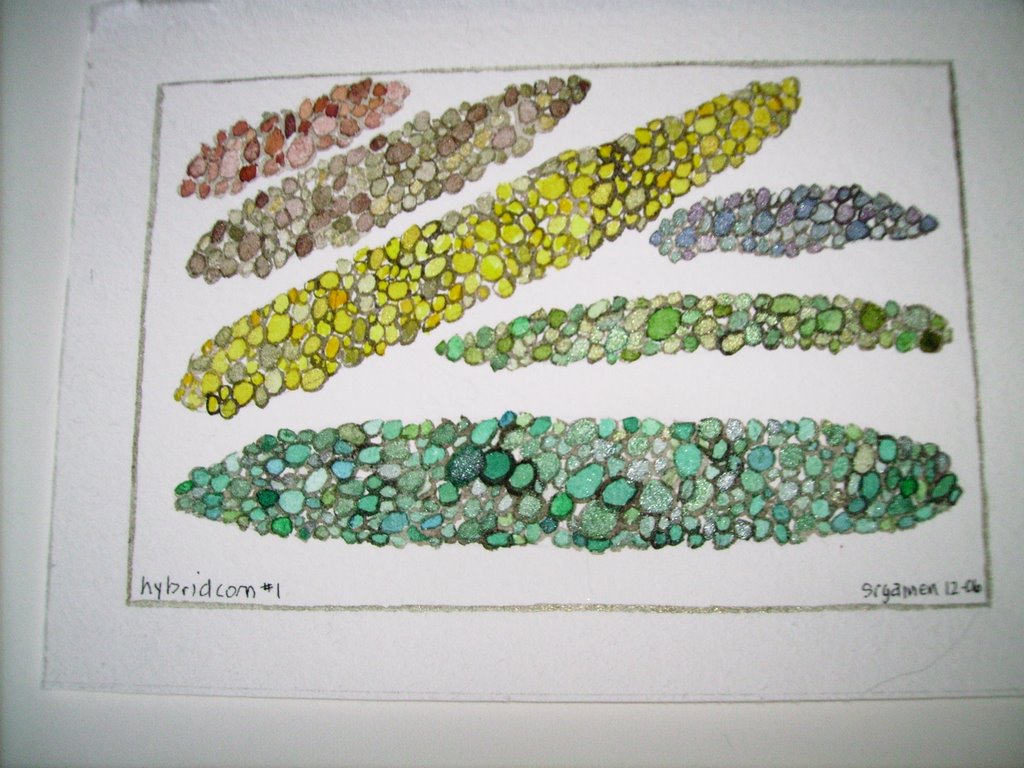
Really really hybridized corn - a very early nanoscape...I promise not to give up painting to explore plant genetics... If, however, you are interested in homicidal plant geneticists, look for Emma Lathen's Green Grow the Dollars (1982, Simon and Schuster; 1983 Pocket Books). "Emma Lathen" is/was two women who met in the early 1960s in a library at Harvard. One became a lawyer, the other an agricultural economist. Together, they used the device of the Trust Department of the Sloan Guaranty Trust, the third largest bank in the world, and its Senior Vice President, the supremely unflappable John Putnam Thatcher, to explore literate and civilized murder and mayhem in a wide swath of industries. The gore is always off-stage, and they assume that you know that "defenestration" means throwing yourself out the window. It's hard to pick favorites, but those set in the automobile, candy, ice hockey, home-delivered fried chicken and oil businesses come quickly to mind. They also wrote together as R.B. Dominic, with just five books featuring Ben Safford, a Congressman from Ohio. Using the power of Congressional investigation, they explored Supreme Court appointments, defense contracting, wildly abusive medical professionals (before it was "normal" for doctors to testify against one another in malpractice suits), and my personal favorite, Murder Sunny Side Up (Paperjacks, Ltd., 1985), which centers on a process for producing shelf-stable "fresh" eggs. Sadly, the Dominic books are out of print, but you can often find them used.
Saturday, December 16, 2006
Cashew Brittle and the Gift of the Candy Thermometer
If you give the gift of five pounds of candy, the recipient will be sick for a week.Whether you are playing an instrument or playing golf or playing the radio, using the best tools and equipment makes the activities easier and more pleasant. You can, of course, make this recipe without a candy thermometer by learning the rules of "soft-crack" and "hard-crack" stages of boiling sugar, and you can get by without either parchment paper or silicone mats, but you will have to deal with the messy cleanup after having to buttered the baking sheets. Your choice. You are, after all, the boss of you.
However, if you give the gift of a Candy Thermometer, the recipient will be able to make
jam, jelly, Italian meringue, caramels and Cashew Brittle -- and you may reap your just rewards (or just desserts.)
- To double or not to double? With the Bergin Nut Company in my back yard, I will always buy cashews in five-pound bags, and I will also always roast all of the nuts because roasted nuts are better to my taste. Extras go in the freezer.
- Would I double the brittle recipe or make it in small batches? Until I have factory-style equipment (giant sugar-stirring machinery), I'll continue to make small batches.
- Would I leave boiling sugar unattended for any length of time? No way. Turn on your I-pod, the TV or the radio, or grab a book -- but stay nearby. Boiling sugar is really really hot, and boiled-over sugar makes an incredibly awful mess.
CASHEW BRITTLE
EQUIPMENT:
3 qt saucepan
2 large rimmed baking sheets
parchment paper or silicon baking mats
silicon spoon or spatula
clip-on candy thermometer
@@@@@@
2 cups of sugar
1 cup of vanilla-flavored light corn syrup
1/2 cup water
1 cup (2 sticks) of unsalted butter
scant 1/8 tsp dried red pepper flakes (OPTIONAL)
3 cups roasted (not salted) cashews or cashew pieces
1 tsp baking soda, sifted
1. Roast cashews: Heat the oven to 350 (regular or convection oven). Cover baking sheets with parchment or silicone and spread the cashews in one level. Bake, stirring every 10 minutes, until the nuts are toasted to your satisfaction.
2. Make caramel: In a 3-quart saucepan, mix the sugar, corn syrup, water. Bring to a boil and stir until the sugar has dissolved. Add the butter and optional red pepper flakes. When the butter has melted, clip your CANDY THERMOMETER to the pan. Reduce the heat to medium and boil at a moderate rate, stirring occasionally, until the mixture reaches 280 degrees (soft-crack stage). This might take 30-40 minutes.
3. Cook caramel and cashews: Add the cashews and stir. When they first are in the pot, the mixture will seize up because you have lowered the temperature and the sugar is angry. Keep stirring to loosen it up, and then stir often until it reaches 300 degrees (hard-crack stage). This may take another 20 minutes.
4. The Mixture Foams: When the mixture reaches 300 degrees, remove it from the heat and add the baking soda. The mixture will foam. Keep stirring until the whole mixture has achieved foaminess. Quickly, pour the mixture onto two parchment or silicon-covered baking sheets. Spread as the mixture as thinly as you can while it is still hot.
5. Cut it up! When it has cooled a bit -- still really too hot to handle -- lift one of the planks of brittle onto a cutting board sitting inside a rimmed baking sheet (which will capture the flying brittle shards). As soon as you can, begin to cut the brittle into strips and then into bite-sized pieces. Store air tight.
Tuesday, December 12, 2006
Spiced Pecans
My friend Kimm Walton (author of Guerilla Tactics for Getting the Legal Job of Your Dreams), "introduced" me to Ann Hodgman several years ago when she sent me a copy of Beat That! (1995, Chapters Publishing, Ltd., Shelburne, VT). Kimm and I have discussed going to Ann's house to worship in her front yard in gracious grateful thanks for SPICED PECANS. This book is full of other fabulous things, including Snow Pea Salad (best on earth!), Cranberry Chutney, Ginger Honey, and Ginger Squares (a very pleasant surprise for someone grabbing a Blondie.)
But on to the pecans...I first made these for a party, dutifully following the recipe and making one pound. The guests inhaled them until there was but one left. It was on the floor and people were circling, but one of my cats batted it away. Never again have I made fewer than 5 pounds, which freeze beautifully, becoming pantry staples. If you must make fewer than 5 pounds, do the math yourself.
This is a two-day or early a.m. and then late p.m. project. Don't be intimidated. All you have to do is boil water, divide by four, turn on the oven, stir the nuts while they bake, and then toss them with spices when they are brown.
SPICED PECANS (adapted from Beat That!)
Day 1 - STEP 1: Boil the pecans
Day 1 - STEP 2: Soak the pecans at room temperature
Day 2 - STEP 3: 12-24 hours later, bake at 350 degrees (conventional or convection),stirring every 5-10 minutes until they are deep deep brown.
Day 2 - STEP 4: Toss with spices
INGREDIENTS AND TOOLS for Step 1 (boil)
5 pounds of whole raw pecans, divided by four
a large pot of boiling water
a colander for draining
INGREDIENTS AND TOOLS For Step 2 (soak)
4 bowls that you can cover with plastic
2 cups white sugar, divided by four
2 sticks of butter, divided by four
8 T light corn syrup, divided by four
4-8 T vanilla
INGREDIENTS FOR STEP 4
Mix the following in a small bowl, and divide by four.
1-1/2 tsp salt
1-1/2 tsp ground coriander
1-1/2 tsp ground cinnamon
1-1/2 tsp fresh grated nutmeg
1-1/2 tsp ground allspice
1-1/2 tsp fresh ground pepper (white pepper is nice)
1. STEP 1 BOIL Boil the water. Boil each bowl of pecans for 1 minute.
2. STEP 2 SOAK Drain carefully, and toss with the melted butter, sugar, corn syrup and vanilla. Store covered at room temperature.
3. STEP 3 BAKE 12-24 hours later...In a 350 degree oven (or, better yet, in a 350 degree convection oven), bake each bowl of pecans until they are quite brown. Ann Hodgman says to aim for "deep, mahogany brown." Less than that and they won't be crisp. This goes quickly with two baking sheets at a time. A word to the wise: do not walk away from this task, and do not imagine that you can do this without stirring.
4. STEP 4 TOSS Mix the spices and divide into four small bowls. When your nuts are brown, return them to their soaking bowls and toss with 1/4 of the spices. Cool on a baking sheet. Store in zipper bags in the freezer.
Notes:
1. Why don't you have four bowls?
2. Bake these on the weapons-grade rimmed baking sheets that come from restaurant supply houses (Hockenbergs in the Twin Cities).
3. Buy your nuts from a wholesaler (Bergin Nut Co., in the Twin Cities) or from a co-op.
4. This is a surprising flexible recipe. I have mistaken curry for cinnamon and no one complained. It was an honest mistake and they are near to one another in my alphabetically organized spice rack, a habit leftover from years of representing Spice Islands when I worked for a San Francisco-based food broker.)
But on to the pecans...I first made these for a party, dutifully following the recipe and making one pound. The guests inhaled them until there was but one left. It was on the floor and people were circling, but one of my cats batted it away. Never again have I made fewer than 5 pounds, which freeze beautifully, becoming pantry staples. If you must make fewer than 5 pounds, do the math yourself.
This is a two-day or early a.m. and then late p.m. project. Don't be intimidated. All you have to do is boil water, divide by four, turn on the oven, stir the nuts while they bake, and then toss them with spices when they are brown.
SPICED PECANS (adapted from Beat That!)
Day 1 - STEP 1: Boil the pecans
Day 1 - STEP 2: Soak the pecans at room temperature
Day 2 - STEP 3: 12-24 hours later, bake at 350 degrees (conventional or convection),stirring every 5-10 minutes until they are deep deep brown.
Day 2 - STEP 4: Toss with spices
INGREDIENTS AND TOOLS for Step 1 (boil)
5 pounds of whole raw pecans, divided by four
a large pot of boiling water
a colander for draining
INGREDIENTS AND TOOLS For Step 2 (soak)
4 bowls that you can cover with plastic
2 cups white sugar, divided by four
2 sticks of butter, divided by four
8 T light corn syrup, divided by four
4-8 T vanilla
INGREDIENTS FOR STEP 4
Mix the following in a small bowl, and divide by four.
1-1/2 tsp salt
1-1/2 tsp ground coriander
1-1/2 tsp ground cinnamon
1-1/2 tsp fresh grated nutmeg
1-1/2 tsp ground allspice
1-1/2 tsp fresh ground pepper (white pepper is nice)
1. STEP 1 BOIL Boil the water. Boil each bowl of pecans for 1 minute.
2. STEP 2 SOAK Drain carefully, and toss with the melted butter, sugar, corn syrup and vanilla. Store covered at room temperature.
3. STEP 3 BAKE 12-24 hours later...In a 350 degree oven (or, better yet, in a 350 degree convection oven), bake each bowl of pecans until they are quite brown. Ann Hodgman says to aim for "deep, mahogany brown." Less than that and they won't be crisp. This goes quickly with two baking sheets at a time. A word to the wise: do not walk away from this task, and do not imagine that you can do this without stirring.
4. STEP 4 TOSS Mix the spices and divide into four small bowls. When your nuts are brown, return them to their soaking bowls and toss with 1/4 of the spices. Cool on a baking sheet. Store in zipper bags in the freezer.
Notes:
1. Why don't you have four bowls?
2. Bake these on the weapons-grade rimmed baking sheets that come from restaurant supply houses (Hockenbergs in the Twin Cities).
3. Buy your nuts from a wholesaler (Bergin Nut Co., in the Twin Cities) or from a co-op.
4. This is a surprising flexible recipe. I have mistaken curry for cinnamon and no one complained. It was an honest mistake and they are near to one another in my alphabetically organized spice rack, a habit leftover from years of representing Spice Islands when I worked for a San Francisco-based food broker.)
Saturday, December 09, 2006
Scallion Pancakes (5 steps)
Scallion Pancake Week (May 1-5, 2006)
Adapted from three wonderful cookbooks:
The Modern Art of Chinese Cooking (Barbara Tropp)
China Moon Cookbook (Barbara Tropp)
China Express (Nina Simonds)
I first had Scallion Pancakes in the late 1970s at an otherwise undistinguished strip-mall Chinese restaurant in San Jose, in the days when you ate Chinese and went for ice cream -- yet another of the sound culinary traditions that has been tromped by our troublesome obsession with cholesterol. My Mother – not a fan of frivolous food – was quite fond of them.
Fast forward to 2006, and time to revisit Scallion Pancakes in a most interesting week in May:
Monday: As written, Tropp’s China Moon pancakes are inedible. She describes them as a “gussied up” version of the scallion pancakes in her first exemplary cookbook, The Modern Art of Chinese Cookery. Not in my kitchen – they were tough and poisonously salty.
Wednesday: Simonds’ China Express pancakes are delicious, but far too complicated to be a “fun” food for entertaining. She does, however, use cake flour, which makes an incredibly tender pancake.
Thursday: Go to the source. Although it requires making a cold and a hot dough, the Tropp’s Modern Art pancakes are simple (five steps, puffy, tender and delicious. She gives helpful instructions for freezing so that they can be a handy appetizer.
FOR 2 seven-inch pancakes:
Equipment
Food processor, silicon mat (optional but excellent) or parchment, rolling pin
Cold water dough 1 cup all purpose flour
2 tsp baking powder
1/3 cup cold water
Boiling water dough 1 cup all purpose flour (or ½ cup all purpose and ½ cup cake flour)
1/2 tsp kosher salt (or 2 tsp table salt)
1/3 cup boiling water
For the dough bowl & filling 1 T plus 2-3 tsp sesame oil or hot chili oil*
2-3 whole scallions, sliced into very thin rings
1. Make the dough: Cold dough: Put the flour and the baking powder into the food processor. Slowly add the water and process just until the dough forms a ball. Remove it from the bowl and reserve. Hot dough: Put the flour and salt into the food processor. Slowly add the boiling water and process just until it forms a ball. Add the cold dough to the hot dough in the work bowl and process for 15 seconds.
2. Form the ball: Remove the ball and knead until smooth on a silicone mat for about 2 minutes. If it starts to stick, add some flour. Coat the inside of a small bowl with a tablespoon of sesame oil. Roll the dough in the oil and cover the bowl with a towel for 30-45 minutes.
3. Make the pancakes: Turn the dough out onto the mat. Knead until smooth (1-2 minutes), adding flour if it gets sticky. Cut the dough in half, leaving one piece in the oiled bowl. Roll the dough to about a 1/8-inch thickness and don’t worry if it isn’t perfectly round. Brush lightly with sesame or chili oil and sprinkle the scallions all over. The scallions should look like a moderate case of zitz, not like a wall-to-wall carpet.
4. Roll and coil: Roll the dough up like a cigar (not too tightly), and then coil into a spiral. Press the ends together. Flatten the spiral with your hands or a rolling pin to about 7” in diameter. Cook immediately or cover with a towel for about half an hour for a more tender pancake.
5. Cook (fry and steam) the pancake: Heat a heavy skillet on high. Add a small amount of oil (to about 1/8”) and heat until a scallion ring sizzles. Add the pancake, reduce the heat and cover for 2-5 minutes. Watch it carefully so that it doesn’t scorch. Flip it, reduce the heat and cook for 3-5 minutes more, checking every 30 seconds to keep it from burning. Serve immediately.
Freezing option: Freeze flat, uncovered at the end of Step 4. When completely frozen, wrap tightly. Partially defrost in the refrigerator and cook as in #5, but on slightly lower heat.
* In China Moon (page 10), Tropp has an excellent recipe for Chili Oil with chili flakes, dried black beans, fresh ginger and garlic, which, if used in Step 5, makes a very zingy pancake.
The Modern Art of Chinese Cooking (Barbara Tropp)
China Moon Cookbook (Barbara Tropp)
China Express (Nina Simonds)
I first had Scallion Pancakes in the late 1970s at an otherwise undistinguished strip-mall Chinese restaurant in San Jose, in the days when you ate Chinese and went for ice cream -- yet another of the sound culinary traditions that has been tromped by our troublesome obsession with cholesterol. My Mother – not a fan of frivolous food – was quite fond of them.
Fast forward to 2006, and time to revisit Scallion Pancakes in a most interesting week in May:
Monday: As written, Tropp’s China Moon pancakes are inedible. She describes them as a “gussied up” version of the scallion pancakes in her first exemplary cookbook, The Modern Art of Chinese Cookery. Not in my kitchen – they were tough and poisonously salty.
Wednesday: Simonds’ China Express pancakes are delicious, but far too complicated to be a “fun” food for entertaining. She does, however, use cake flour, which makes an incredibly tender pancake.
Thursday: Go to the source. Although it requires making a cold and a hot dough, the Tropp’s Modern Art pancakes are simple (five steps, puffy, tender and delicious. She gives helpful instructions for freezing so that they can be a handy appetizer.
FOR 2 seven-inch pancakes:
Equipment
Food processor, silicon mat (optional but excellent) or parchment, rolling pin
Cold water dough 1 cup all purpose flour
2 tsp baking powder
1/3 cup cold water
Boiling water dough 1 cup all purpose flour (or ½ cup all purpose and ½ cup cake flour)
1/2 tsp kosher salt (or 2 tsp table salt)
1/3 cup boiling water
For the dough bowl & filling 1 T plus 2-3 tsp sesame oil or hot chili oil*
2-3 whole scallions, sliced into very thin rings
1. Make the dough: Cold dough: Put the flour and the baking powder into the food processor. Slowly add the water and process just until the dough forms a ball. Remove it from the bowl and reserve. Hot dough: Put the flour and salt into the food processor. Slowly add the boiling water and process just until it forms a ball. Add the cold dough to the hot dough in the work bowl and process for 15 seconds.
2. Form the ball: Remove the ball and knead until smooth on a silicone mat for about 2 minutes. If it starts to stick, add some flour. Coat the inside of a small bowl with a tablespoon of sesame oil. Roll the dough in the oil and cover the bowl with a towel for 30-45 minutes.
3. Make the pancakes: Turn the dough out onto the mat. Knead until smooth (1-2 minutes), adding flour if it gets sticky. Cut the dough in half, leaving one piece in the oiled bowl. Roll the dough to about a 1/8-inch thickness and don’t worry if it isn’t perfectly round. Brush lightly with sesame or chili oil and sprinkle the scallions all over. The scallions should look like a moderate case of zitz, not like a wall-to-wall carpet.
4. Roll and coil: Roll the dough up like a cigar (not too tightly), and then coil into a spiral. Press the ends together. Flatten the spiral with your hands or a rolling pin to about 7” in diameter. Cook immediately or cover with a towel for about half an hour for a more tender pancake.
5. Cook (fry and steam) the pancake: Heat a heavy skillet on high. Add a small amount of oil (to about 1/8”) and heat until a scallion ring sizzles. Add the pancake, reduce the heat and cover for 2-5 minutes. Watch it carefully so that it doesn’t scorch. Flip it, reduce the heat and cook for 3-5 minutes more, checking every 30 seconds to keep it from burning. Serve immediately.
Freezing option: Freeze flat, uncovered at the end of Step 4. When completely frozen, wrap tightly. Partially defrost in the refrigerator and cook as in #5, but on slightly lower heat.
* In China Moon (page 10), Tropp has an excellent recipe for Chili Oil with chili flakes, dried black beans, fresh ginger and garlic, which, if used in Step 5, makes a very zingy pancake.
"$100 Almonds" in four easy steps
If you have an hour to spare and are looking for something that will inspire "Did You MAKE these??", try "$100 Almonds" which I first made on Labor Day 2000. And it was a laborious day...
THE WRONG WAY
The best food writers implore their readers to read the recipe before you begin. Although not in their league, I beg you to read the recipe before you SHOP.
I read, but didn't write down the recipe, and bought raw instead of blanched almonds. It took three hours to blanch 1-1/2 pounds of almonds. (NOTE: To blanch almonds, dip in very hot water for about 10 seconds, and then remove the peel. Almond by almond. One at a time. Very tedious.)
A more focused almond blancher would have thrown the almond peels into the trash instead of into the garbage disposer which promptly clogged. Adding the $89 plumbing bill to the $8.49 for almonds and $2 for chocolate created "$100 Almonds."
Correctly prepared, this recipe takes an hour. It is ridiculously simple.
THE RIGHT WAY
"Roasted & Frosted & Chocolate Almonds"
(adapted from"Handcraft Illustrated" Fall 1998.)
1 # (6 cups) whole blanched almonds
1 cup water
1 cup sugar
dash of salt
2 oz semisweet, really good chocolate
IDEAL TOOLS:
Restaurant-quality sheet pans (won't warp)
Large non-stick saucepan (for easy cleanup)
Silicon spoon or spatula (for stirring sticky sugar)
Parchment paper or silicon liner (for easy cleanup)
1. ROAST ALMONDS Preheat the oven to 350. Spread the almonds in a single layer and roast for 10 minutes or until slightly brown and fragrant. Remove from the oven and cool for 5 minutes. Set aside 2 cups in a large bowl.
2. FROST ALMONDS Combine water, sugar and salt in a large preferably non-stick saucepan. Stir until the sugar is dissolved. Add 4 cups of roasted almonds. Cook over medium heat, stirring with a silicon (or wooden) spoon until the water evaporates and sugar crystals form. (This is AMAZING) Spread on a baking sheet and cool 30 minutes. Add 2 cups of frosted almonds to the 2 cups of roasted almonds in the large bowl.
3. DRIZZLE CHOCOLATE. Spread the remaining 2 cups of almonds on a parchment-covered baking sheet. Put the chocolate in an unsealed freezer bag and microwave 1-1/2 minutes on medium power or until melted. Cut off the tip of the bag and drizzle chocolate on the remaining almonds. Cool overnight.
4. MIX the roasted, frosted chocolate almonds and store airtight.
NOTES:
1. Buy a serious baking sheet from a restaurant supply house such as Hochenbergs on Kasota in St. Paul, MN. For about $6, you''' have weapons-grade, yours-for-a-lifetime heavy baking sheets measuring 12x19 inches, which would cost at least $15 in an Important Cooking Store.
2. If you buy five pounds of almonds, you will need three baking sheets to prepare this recipe efficiently,
3. Separating the almonds after they are frosted and after they are chocolate-drizzled is a very nice thing to do for your friends and family who will love these things. Or, leave them clumped and call it all "Bark."
4. You can use LOTS more chocolate, and you can mix white and dark.
5. FOR EXTREME DECADENCE, drizzle one side of the almonds and let the chocolate set. Do not separate the nuts. Cover the baking sheet with wax paper or parchment and flip them. Drizzle the second side. Let the chocolate set and THEN separate the nuts.
12/06
Tuesday, December 05, 2006
Fried Green Eggs - a nanoscapes
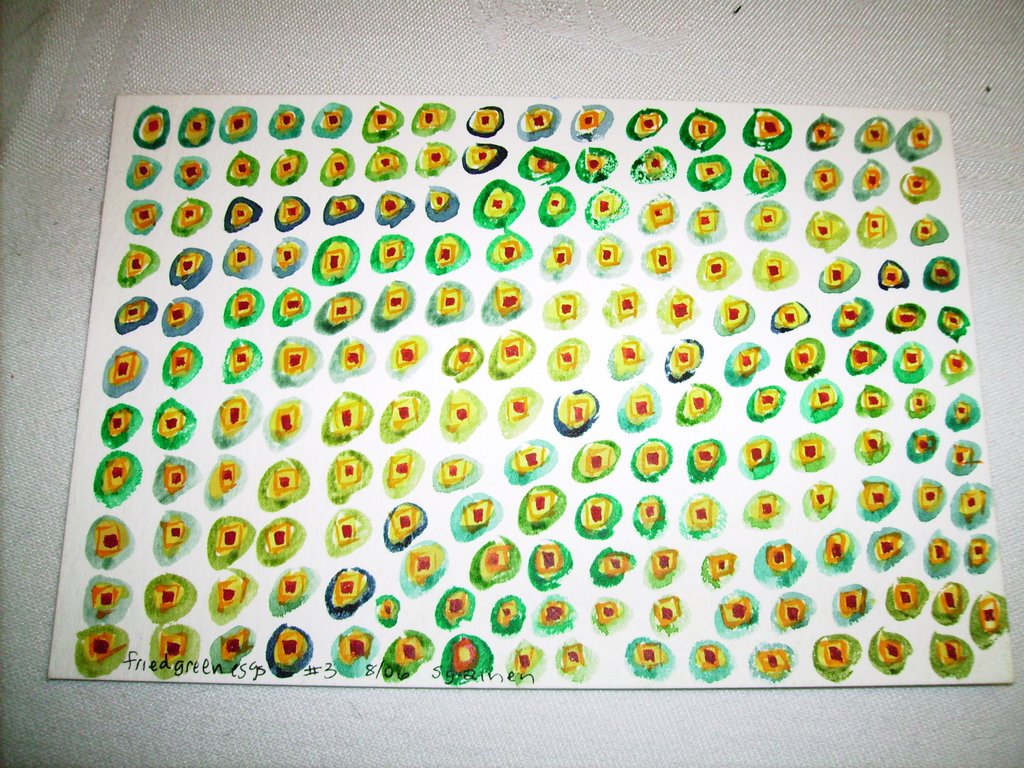
During the summer of 2006 I discovered watercolors, and I will, occasionally, post a painting. This was one of two very early food-related series. The first was "Demented Olives," and this is from the "Fried Green Eggs Group."
June 2010 UPDATE: nanoscapes have taken a decidedly unexpected turn. They have grown from post-card sized paintings, such as Fried Green Eggs, to much larger geometric abstractions including Connectivity (1-4), Fractured Glass (1 and 2), and a host of Bright Boxes and Boxes & Dots.
Monday, December 04, 2006
No-Knead Bread With Crisp Crust For Ever & Ever. Amen.
On November 8, 2006, Mark Bittman’s NYTimes column struck fear and terror into the hearts of bread machine manufacturers, and brought joy to anyone who might have wanted to make bread but had lists of “why I can’t bake bread…,” “why I could never touch dough…,” “why I don’t have the time…” or “why there is no space on my countertop…”
This will make plain and perfect bread with an insanely crisp crust that only comes from commercial ovens or, perhaps, the ridiculously expensive ovens that are all too frequently installed in McMansion Kitchens and never used. Make it twice and you’ll never need the recipe. And, oh, by the way, there is NO KNEADING.
Bittman’s recipe which he adapted from Jim Lahey of the Sullivan Street Bakery (a GOD to all who love bread) is both stupid simple and fool proof, and I speak from experience. Four ingredients. Who could err? Moi. But the recipe really is fool proof. And adaptable. Makes Cheese Bread or Pepper Bread…
3 cups all purpose flour
¼ tsp instant (rapid rise) yeast with a package date in this century
1-1/4 tsp salt
1-5/8 cups water
1. Mix the flour, yeast and salt in a mixing bowl with a fork or a whisk. Add the water and stir until the flour has disappeared. This will be sticky and shaggy. Cover with plastic wrap and walk away for between 18 and 24 hours.
2. Flour a board. Scrape the very relaxed and sticky dough onto the board. Flouring the dough a bit, fold it over on itself. A silicone spatula is very helpful here. Cover for 15 minutes with the same piece of plastic wrap.
3. This is the fun part: take a cotton dish towel and sprinkle half with corn meal or flour. Using your silicone spatula, scrape the now very very relaxed dough onto the corn meal. Cover with the other half of the dish towel. Set a timer for 90 minutes.
4. After 90 minutes, put a 6-8 quart pot (cast iron, enamel or Pyrex) with a lid into the oven and heat to 450 degrees. Set the timer for 30 minutes.
5. After 30 minutes, remove the pot and lid. Carefully dump the dough into the pot. Slap the lid back on. Return the pot to the oven and bake for 30 minutes.
6. Remove the pot cover and bake for an additional 30 minutes. Remove the bread from the pot and let it cool on a rack.
How foolproof is this?
1. If you add too much water (an additional 5/8 cup, for instance), your bread will be a bit doughy, but otherwise fine. If I make that mistake again, I’ll add 15 minutes to the covered baking time.
2. Old yeast is fine. New yeast is excellent.
Because my pals wanted to know how to make cheese bread or a seasoned loaf, and I was concerned about adding ingredients to a yeast dough (“It’s alive!!”) without having the dough turn alarming shades of green or blue, I experimented:
3. For Cheese Bread Tipping my hat to the Stud Muffin cheese bread in Rose Levy Berenbaum’s classic The Bread Bible, I added 2 oz grated Parmesan and 2 oz grated Romano and either 1/8 tsp cayenne or ¼ tsp cracked black pepper to the dry ingredients.
4. For Pepper Bread Add ¼ tsp cayenne and ¼ tsp black pepper to the dry ingredients.
This will make plain and perfect bread with an insanely crisp crust that only comes from commercial ovens or, perhaps, the ridiculously expensive ovens that are all too frequently installed in McMansion Kitchens and never used. Make it twice and you’ll never need the recipe. And, oh, by the way, there is NO KNEADING.
Bittman’s recipe which he adapted from Jim Lahey of the Sullivan Street Bakery (a GOD to all who love bread) is both stupid simple and fool proof, and I speak from experience. Four ingredients. Who could err? Moi. But the recipe really is fool proof. And adaptable. Makes Cheese Bread or Pepper Bread…
3 cups all purpose flour
¼ tsp instant (rapid rise) yeast with a package date in this century
1-1/4 tsp salt
1-5/8 cups water
1. Mix the flour, yeast and salt in a mixing bowl with a fork or a whisk. Add the water and stir until the flour has disappeared. This will be sticky and shaggy. Cover with plastic wrap and walk away for between 18 and 24 hours.
2. Flour a board. Scrape the very relaxed and sticky dough onto the board. Flouring the dough a bit, fold it over on itself. A silicone spatula is very helpful here. Cover for 15 minutes with the same piece of plastic wrap.
3. This is the fun part: take a cotton dish towel and sprinkle half with corn meal or flour. Using your silicone spatula, scrape the now very very relaxed dough onto the corn meal. Cover with the other half of the dish towel. Set a timer for 90 minutes.
4. After 90 minutes, put a 6-8 quart pot (cast iron, enamel or Pyrex) with a lid into the oven and heat to 450 degrees. Set the timer for 30 minutes.
5. After 30 minutes, remove the pot and lid. Carefully dump the dough into the pot. Slap the lid back on. Return the pot to the oven and bake for 30 minutes.
6. Remove the pot cover and bake for an additional 30 minutes. Remove the bread from the pot and let it cool on a rack.
How foolproof is this?
1. If you add too much water (an additional 5/8 cup, for instance), your bread will be a bit doughy, but otherwise fine. If I make that mistake again, I’ll add 15 minutes to the covered baking time.
2. Old yeast is fine. New yeast is excellent.
Because my pals wanted to know how to make cheese bread or a seasoned loaf, and I was concerned about adding ingredients to a yeast dough (“It’s alive!!”) without having the dough turn alarming shades of green or blue, I experimented:
3. For Cheese Bread Tipping my hat to the Stud Muffin cheese bread in Rose Levy Berenbaum’s classic The Bread Bible, I added 2 oz grated Parmesan and 2 oz grated Romano and either 1/8 tsp cayenne or ¼ tsp cracked black pepper to the dry ingredients.
4. For Pepper Bread Add ¼ tsp cayenne and ¼ tsp black pepper to the dry ingredients.
The Delights of Winter Tomatoes - No Kidding
Fresh winter Roma tomatoes taste like the spawn of cardboard and cotton, and not in the vaguely good way you might remember the cotton candy you ate at the circus when you were six.
But with some oil and garlic and some patience, you can create something that guests will fight over – if you decide to share. I can’t imagine how good this would be with Height of Summer Tomatoes – but who would turn on the oven for three hours in July?? Fortunately, winter Romas are cheap, so you can make this often.
******
2 pounds (or more) Roma tomatoes, cut in eighths (sliced the long way)
5-6 cloves garlic, crushed (or ½ tsp dried minced garlic added midway through baking)
¼ cup olive oil
1 tsp red pepper flakes (more or less to your taste)
1/2 red or yellow bell pepper, cut in ½ inch dice (optional)
salt and pepper
1. Heat the oven to 325.
2. Cut the tomatoes. Crush the garlic and dice the bell pepper.
3. Combine the ingredients in a shallow roasting pan. NOTE: If you use a rimmed cookie sheet, you will certainly have to clean the oven.
4. Roast for 3 hours, stirring twice an hour.
5. If you can resist the temptation to eat these tomatoes right out of the pan, leaving no need for creative use of leftovers, you might:
But with some oil and garlic and some patience, you can create something that guests will fight over – if you decide to share. I can’t imagine how good this would be with Height of Summer Tomatoes – but who would turn on the oven for three hours in July?? Fortunately, winter Romas are cheap, so you can make this often.
******
2 pounds (or more) Roma tomatoes, cut in eighths (sliced the long way)
5-6 cloves garlic, crushed (or ½ tsp dried minced garlic added midway through baking)
¼ cup olive oil
1 tsp red pepper flakes (more or less to your taste)
1/2 red or yellow bell pepper, cut in ½ inch dice (optional)
salt and pepper
1. Heat the oven to 325.
2. Cut the tomatoes. Crush the garlic and dice the bell pepper.
3. Combine the ingredients in a shallow roasting pan. NOTE: If you use a rimmed cookie sheet, you will certainly have to clean the oven.
4. Roast for 3 hours, stirring twice an hour.
5. If you can resist the temptation to eat these tomatoes right out of the pan, leaving no need for creative use of leftovers, you might:
a. Use in place of fresh tomatoes in Mark Bittman’s Tomato Curried Scallops;
b. Layer on a grilled cheese sandwich;
c. Serve alongside any grilled meat or fish;
d. Add to salads;
e. Process with some Italian cheese and serve over pasta;
f. Use as a layer in a terrine.
Other references to food like this:
1. I first read about something like this years ago in Laurie Colwin’s More Home Cooking (HarperCollins, 1993, pp. 111-112). She’d had it at "a very fancy buffet as a side dish...or condiment....Whatever it was, I tried not to disgrace myself by eating enormous quantities of it, but I was not successful. I could not get enough. Finally I snagged a waiter and begged him to tell me what it was." The waiter said to take drain canned plum tomatoes and roast them with garlic and olive oil -- for an undesignated "long time." If you need more reminders that Laurie Colwin was a writer to be reckoned with, she concludes "With a loaf of bread and a bean salad, this makes a dinner I would walk through fire for." 'Nuff said.
Other references to food like this:
1. I first read about something like this years ago in Laurie Colwin’s More Home Cooking (HarperCollins, 1993, pp. 111-112). She’d had it at "a very fancy buffet as a side dish...or condiment....Whatever it was, I tried not to disgrace myself by eating enormous quantities of it, but I was not successful. I could not get enough. Finally I snagged a waiter and begged him to tell me what it was." The waiter said to take drain canned plum tomatoes and roast them with garlic and olive oil -- for an undesignated "long time." If you need more reminders that Laurie Colwin was a writer to be reckoned with, she concludes "With a loaf of bread and a bean salad, this makes a dinner I would walk through fire for." 'Nuff said.
2. James Peterson has two wonderful recipes in Vegetables: The Most Authoritative Guide to Buying, Preparing, and Cooking with More Than 300 Recipes (William Morrow and Company, Inc.,1998, pp. 260-261), one for "Slow-baked Cherry Tomatoes with Herbs" and another for "Roasted [fresh] Tomatoes."
3. Google “roasted tomatoes.” Have fun.Wednesday, August 02, 2006
Beige Lunch
August 1, 2006...With nearly 200 other lucky folks, I heard Leon Panetta speak at Graves 601 today. He gave a great speech, but that's not the story. The story is Beige Lunch.
We were served a 100% Beige Lunch: beige-not-golden-roasted free range chicken (excellent -- I wanted to hug the chicken), beautifully thin-sliced potatoes baked in a slurry of yummy butter, and a pile of perfectly sauteed mushrooms. All beige. Not one single sprig or leaf of parsley. Beige. Beige. Beige.
After lunch, I politely inquired about this beige-ness -- it might, after all, have been a kitchen crisis in which the dog ate the parsley or the produce buyer was kidnapped by space aliens. A friendly server who admitted that she was inordinately fond of beige herself, said, yes, the food was beige on purpose. The hotel has a minimalist style that flows all the way through to the food. She did say that if I were to hold an event, that I could ask for green vegetables and parsley sprinkles and she hinted that the chef would comply.
I also asked if there were a pink lunch or some other color or non-color of monochrome lunch. She thought not.
In any event, it was a free (many thanks to sponsor Fleishmann-Hillard), so I'm not complaining.
We were served a 100% Beige Lunch: beige-not-golden-roasted free range chicken (excellent -- I wanted to hug the chicken), beautifully thin-sliced potatoes baked in a slurry of yummy butter, and a pile of perfectly sauteed mushrooms. All beige. Not one single sprig or leaf of parsley. Beige. Beige. Beige.
After lunch, I politely inquired about this beige-ness -- it might, after all, have been a kitchen crisis in which the dog ate the parsley or the produce buyer was kidnapped by space aliens. A friendly server who admitted that she was inordinately fond of beige herself, said, yes, the food was beige on purpose. The hotel has a minimalist style that flows all the way through to the food. She did say that if I were to hold an event, that I could ask for green vegetables and parsley sprinkles and she hinted that the chef would comply.
I also asked if there were a pink lunch or some other color or non-color of monochrome lunch. She thought not.
In any event, it was a free (many thanks to sponsor Fleishmann-Hillard), so I'm not complaining.
Friday, July 21, 2006
Potato and Pea Curry: thank you, Madhur Jaffrey
Madhur Jaffrey’s curries to kebabs:recipes from the Indian Spice Trail is the best kind of cookbook. In the first 34 pages, she writes about “Indian Food around the world: a background” – long enough for the history and culture vultures, but not so long that it takes away from the recipes. Each chapter has begins with an illuminating essay, so cooks and readers are transported on their approach to meats, poultry and eggs, fish & seafood, vegetables, dals, beans and split peas, kebabs and soups, rice, noodles and breads, and relishes and accompaniments. The heading of every recipe has a story – giving context to flavor. Don’t be surprised if you want to make every single dish.
Potato & Pea Curry -- try this one. It taps three skills: measuring, stirring and chopping potatoes. It will work during the spring with new red potatoes, in the summer with farmer’s market tomatoes, and in the winter with supermarket potatoes and tomato paste. It is sweet and hot, with the smoky taste of cumin. Serve this hot, cold or at room temperature. If, as a child, you loved mixing Campbell’s Tomato and Pea Soups to make Puree Mongol, and wondered if it could get any better, the answer is “yes.” This is it.
Cook’s notes:
1. Madhur Jaffrey adds a pinch of ground asafetida to the whole spices. I haven’t had any.
2. When you can get them, use fresh tomatoes, otherwise use 1/3 of a can of tomato paste. Divide the rest into equal size blobs, wrap and store in the freezer.
3. Although probably wildly untraditional, you may substitute frozen corn for the peas.
Whole spices:
Potato & Pea Curry -- try this one. It taps three skills: measuring, stirring and chopping potatoes. It will work during the spring with new red potatoes, in the summer with farmer’s market tomatoes, and in the winter with supermarket potatoes and tomato paste. It is sweet and hot, with the smoky taste of cumin. Serve this hot, cold or at room temperature. If, as a child, you loved mixing Campbell’s Tomato and Pea Soups to make Puree Mongol, and wondered if it could get any better, the answer is “yes.” This is it.
Cook’s notes:
1. Madhur Jaffrey adds a pinch of ground asafetida to the whole spices. I haven’t had any.
2. When you can get them, use fresh tomatoes, otherwise use 1/3 of a can of tomato paste. Divide the rest into equal size blobs, wrap and store in the freezer.
3. Although probably wildly untraditional, you may substitute frozen corn for the peas.
Whole spices:
½ tsp whole brown mustard seed
½ tsp whole cumin seeds
½ tsp dried chili flakes
[generous pinch of ground asafetida: optional]
Dry spices
½ tsp whole cumin seeds
½ tsp dried chili flakes
[generous pinch of ground asafetida: optional]
Dry spices
½ tsp cayenne pepper
1 tsp ground cumin
1 tsp ground coriander
1 tsp sugar
3 T peanut oil
1 pound red potatoes, cut into chunks
2 cups frozen peas (or frozen corn)
1 cup water
1-1/2 tsp salt, divided
1 pound (2-3 medium) tomatoes, grated, or 2 oz tomato paste plus ½ cup of water
1. Put the whole spices in one small dish; put the ground spices in another small dish.
2. Heat the oil in a large, non-stick skillet with a lid. When it’s hot, add the whole spices. Stir until the mustard seeds pop, and add the potatoes, stirring to coat with the spices. Using tongs, lay the potato pieces cut side down. Cook until one side is brown and crispy. Turn and brown a second side.
3. Add the ground spices and stir to coat the potatoes. Add the peas or corn. Add 1 cup of water and 1 tsp of the salt. Bring to a boil, turn down the heat to low and cover. Cook for 15 minutes.
4. Remove the cover, add the tomatoes and the remaining ½ tsp of salt, or the tomato paste and ½ cup of water (no extra salt is necessary).
5. Simmer uncovered for 10 minutes. Serve hot, warm or room temperature.
July 2006
1 tsp ground cumin
1 tsp ground coriander
1 tsp sugar
3 T peanut oil
1 pound red potatoes, cut into chunks
2 cups frozen peas (or frozen corn)
1 cup water
1-1/2 tsp salt, divided
1 pound (2-3 medium) tomatoes, grated, or 2 oz tomato paste plus ½ cup of water
1. Put the whole spices in one small dish; put the ground spices in another small dish.
2. Heat the oil in a large, non-stick skillet with a lid. When it’s hot, add the whole spices. Stir until the mustard seeds pop, and add the potatoes, stirring to coat with the spices. Using tongs, lay the potato pieces cut side down. Cook until one side is brown and crispy. Turn and brown a second side.
3. Add the ground spices and stir to coat the potatoes. Add the peas or corn. Add 1 cup of water and 1 tsp of the salt. Bring to a boil, turn down the heat to low and cover. Cook for 15 minutes.
4. Remove the cover, add the tomatoes and the remaining ½ tsp of salt, or the tomato paste and ½ cup of water (no extra salt is necessary).
5. Simmer uncovered for 10 minutes. Serve hot, warm or room temperature.
July 2006
Saturday, June 10, 2006
Thai-ish Cucumber Salad
1. Infinitely expandable
2. Infinitely flexible
3. Really really easy
4. Even works with semi-tired winter cucumbers
5. And -- a bonus! An opportunity to practice or show off your insanely excellent knife skills
This was inspired by a recipe from David Rosengarten's food newsletter, a cucumber salad that my friends Marc and Elyana Tarlow first made for me in the early 1980s from Annemarie Huste's Annemarie's Cooking School Cookbook, and the fact that I'm always looking for new ways to practice my knife skills. With a sharp knife and a spoon, this recipe is a snap.
*****
2. Infinitely flexible
3. Really really easy
4. Even works with semi-tired winter cucumbers
5. And -- a bonus! An opportunity to practice or show off your insanely excellent knife skills
This was inspired by a recipe from David Rosengarten's food newsletter, a cucumber salad that my friends Marc and Elyana Tarlow first made for me in the early 1980s from Annemarie Huste's Annemarie's Cooking School Cookbook, and the fact that I'm always looking for new ways to practice my knife skills. With a sharp knife and a spoon, this recipe is a snap.
*****
INGREDIENTS
Three large cucumbers
¼ cup Red Pepper (or other flavor) Rice Wine Vinegar
2 tablespoons sugar
¼ tsp red pepper flakes
1 tablespoon (or more) toasted sesame seeds (optional, but gives a nice crunch)
1 small carrot from which to make 2 T carrot brunoise* -- teeny, tiny carrot cubes (optional, but looks great)
¼ cup Red Pepper (or other flavor) Rice Wine Vinegar
2 tablespoons sugar
¼ tsp red pepper flakes
1 tablespoon (or more) toasted sesame seeds (optional, but gives a nice crunch)
1 small carrot from which to make 2 T carrot brunoise* -- teeny, tiny carrot cubes (optional, but looks great)
1. Sesame seeds: Toast them in a small, hot pan. Watch carefully -- they will pop out of the pan like popcorn, and burn quickly. Remove from the pan and let them cool.
2. Cucumbers: Peel, slice in half lengthwise; scoop out the seeds with a teaspoon, a melon ball scoop or a tiny cookie scoop. Cut in thin diagonal slices.
3. Dressing: Combine the rice wine vinegar, sugar, red pepper flakes, optional toasted sesame seeds, and carrot brunoise* in a bowl. Stir to dissolve the sugar. Add the cucumbers.
4. *Brunoise: At last! A dramatic opportunity to practice or show off your insanely excellent knife skills
Cut two or three very thin planks of raw carrot. Cut the thin planks into tiny matchsticks. Cut the matchsticks into teeny, tiny cubes – 3mm or less for correct brunoise.
Cut two or three very thin planks of raw carrot. Cut the thin planks into tiny matchsticks. Cut the matchsticks into teeny, tiny cubes – 3mm or less for correct brunoise.
5. Serving: While you may certainly serve it immediately, this salad benefits from an hour in the refrigerator. After that, serve it cold or at room temperature. This will keep for a few days in the refrigerator.
6. Safe for travel and fun! Because it has no mayo, this is a great salad for picnics and outdoor events.
6. Safe for travel and fun! Because it has no mayo, this is a great salad for picnics and outdoor events.
Subscribe to:
Posts (Atom)